

A laboratory report can look decisive: one product name, one chromatogram, and one large percentage. But a single number cannot answer every quality question. Think of quality review as checking a traveler at a border. A passport helps confirm identity; a luggage inspection asks what else is present; and a scale answers how much is being carried. Each check is useful, but none can replace the others.
Peptide testing follows the same logic. Identity asks whether the expected molecule is present. Purity estimates how much of the measured material is represented by the target component under a stated method. Assay or content asks how much target material is present. A reliable review keeps these questions separate, then brings the evidence together.
Quality starts with a specification
“High quality” is not a complete scientific specification. A useful specification identifies the material, lists the tests to be performed, names or references the analytical procedures, and states the acceptance criteria. Without those details, words such as premium, tested, or laboratory grade are descriptions rather than measurable conclusions.
Quality is also batch-specific. A method may be suitable and a product description may be correct, yet the document still needs to connect to the exact batch or lot being reviewed. The strongest record forms a traceable chain from the label to the batch, from the batch to the sample, and from the sample to the actual analytical result.
Identity: is it the expected molecule?
Peptide identity begins with an exact molecular description. The amino-acid sequence, its direction, terminal modifications, salt or counterion form when relevant, and other declared structural features help define what the target is supposed to be. A matching product name alone is not enough because similar names can describe different sequences or forms.
Identity testing compares measured characteristics with expected characteristics or an appropriate reference. Depending on the material and purpose, evidence may include molecular mass, retention behavior, spectroscopic information, amino-acid analysis, peptide mapping, or a combination of methods. A result is meaningful only when the method is capable of distinguishing the target from plausible alternatives.
Purity: how much of the measured signal belongs to the target?
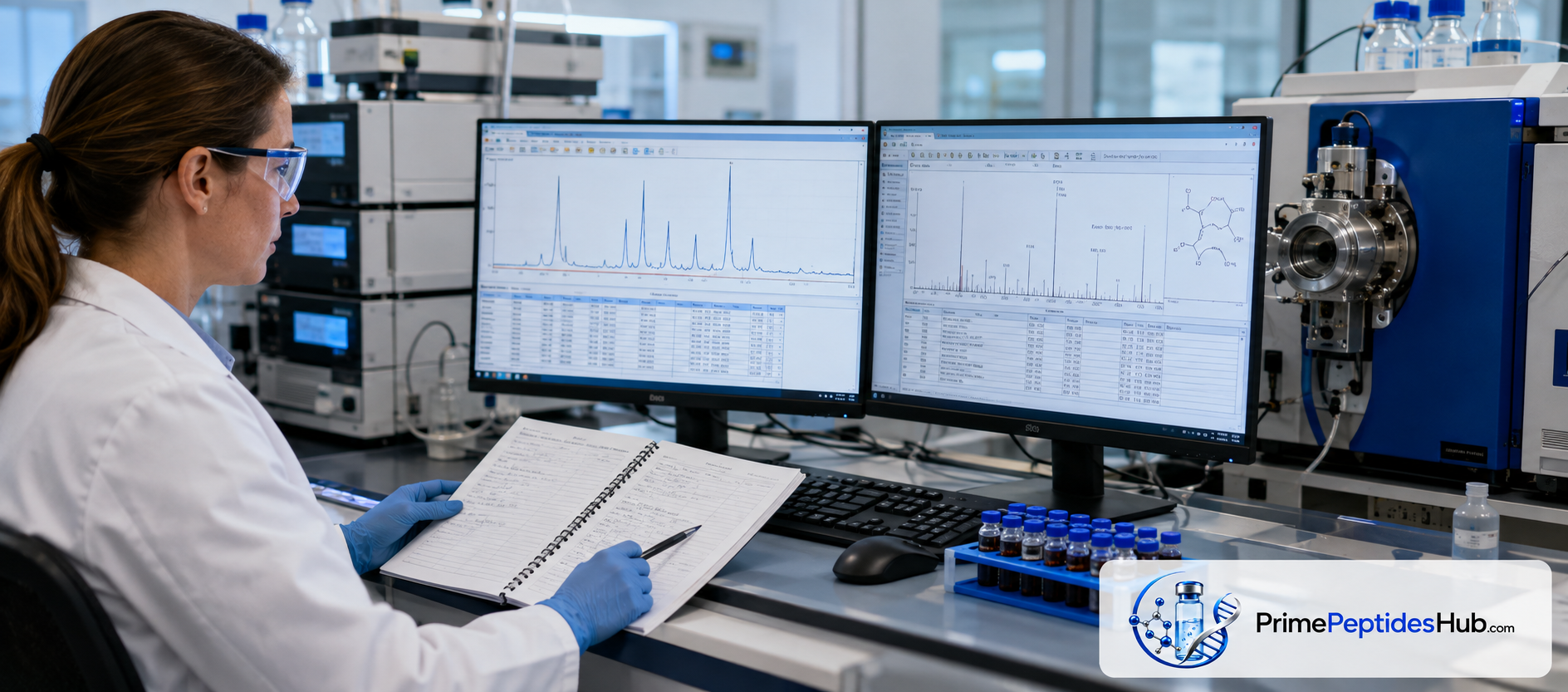
Chromatography is commonly used to separate components in a sample. In an HPLC or UHPLC chromatogram, the horizontal axis usually represents retention time and the vertical signal reflects the detector response. Ideally, different components emerge at different times and appear as separate peaks.
A reported chromatographic purity percentage is often calculated from the area of the target peak relative to the total integrated peak area under the stated conditions. That can be valuable, but it is a relative result produced by a particular method, detector, wavelength, sample preparation, integration approach, and set of reporting rules.
What a purity percentage does—and does not—mean
A result such as 99% chromatographic purity means that the target peak accounted for approximately 99% of the integrated signal included in that calculation under that method. It does not mean that every gram of the physical sample is 99% target peptide by absolute mass, and it should not be detached from the chromatogram and method details that produced it.
The remaining material may include peptide-related variants, degradation products, residual water, counterions, salts, solvents, or other substances that do not all respond equally—or may not appear at all—under one chromatographic detection condition. Separate tests may be needed for water content, residual solvents, inorganic content, microbial limits, endotoxins, particulate matter, or other attributes relevant to the intended research specification.
Comparisons are most informative when laboratories use comparable methods, sample preparation, integration rules, and acceptance criteria. Two reports can show the same percentage while measuring slightly different sets of signals. Conversely, different percentages do not automatically prove that one material is better unless the methods and specifications are understood.
Assay or content is a different question
Purity and quantity are often confused. Imagine a vial containing a very clean sample but less peptide than the label states. Its chromatographic purity could still be high, while its assay or content result is low. The reverse distinction also matters: the expected total quantity does not prove that all measured material is the intended peptide.
Assay aims to estimate the amount or concentration of the target, often by comparison with a suitably characterized reference and a validated quantitative procedure. Interpretation may also need to account for water, residual solvents, salts, counterions, and the chemical form used to express the result. This is why “purity,” “peptide content,” and “net vial quantity” should never be treated as interchangeable labels.
Mass spectrometry adds molecular evidence
Mass spectrometry measures ions according to their mass-to-charge ratio. For a peptide, an observed mass that agrees with the expected molecular mass provides strong evidence supporting identity. High-resolution measurements can improve the ability to distinguish close possibilities, while tandem mass spectrometry can provide fragment information that supports sequence-related identification.
Mass agreement alone is not a complete purity result. A sample can contain the expected peptide and additional components at the same time. Some sequence variants or modifications may also require more detailed analysis to distinguish confidently. Mass spectrometry and chromatography therefore complement one another: one contributes molecular evidence, while the other helps separate and estimate components.

Why one test is rarely enough
A good analytical strategy uses methods that answer different questions or separate materials by different principles. This is sometimes described as an orthogonal approach. Chromatography may reveal separated peaks; mass spectrometry may support molecular identity; water or solvent testing may address components that the main chromatographic method does not measure well.
The method itself must also be fit for purpose. Important validation characteristics can include specificity, accuracy, precision, linearity, range, detection or quantitation limits, and robustness, depending on what the procedure is intended to measure. A sophisticated instrument does not rescue a poorly defined method, an unsuitable reference, or an incorrectly integrated result.
Where peptide impurities can come from
Synthetic peptide production builds a chain step by step. Incomplete coupling, unintended side reactions, or failures during removal of protecting groups can produce peptide-related impurities such as shortened sequences, deletion variants, or other modified forms. Purification is designed to separate these materials, but separation becomes more difficult when an impurity closely resembles the target.
Impurities can also form after synthesis. Oxidation, hydrolysis, deamidation, aggregation, or other changes may occur during processing or storage, depending on the sequence and conditions. A result obtained at release therefore does not replace suitable stability controls, storage records, and testing appropriate to the material.
Process-related substances form another category. Residual solvents, reagents, salts, metals, or purification-related materials may require tests different from those used to measure peptide-related purity. The exact test panel should follow the product specification and the risks associated with the manufacturing process.
Microbiological quality is a separate subject again. Chemical identity and a clean chromatogram do not establish sterility, endotoxin level, or microbial limits. Those claims require their own sampling plans, methods, controls, and results. The central lesson is simple: a test proves only what it was designed and performed to test.
How to read a chromatogram without overclaiming
First locate the target peak and confirm how it was identified. Then review the full chromatogram rather than only the largest peak. Note the retention-time range, smaller peaks, baseline behavior, and whether the displayed scale hides low-level signals. A neat image is helpful, but appearance alone does not establish suitability.
Next examine the method and calculation. Look for the column and mobile-phase information, detector type or wavelength, injection details, reference standard, system-suitability criteria, peak-integration approach, and any threshold below which peaks were excluded. These details explain what the percentage includes and what it may miss.
Finally, compare the chromatogram with the reported table. The named sample, batch number, test date, target result, individual impurities when reported, total impurities, specification, and pass/fail conclusion should agree. Unexplained differences, cropped data, missing units, or absent method references deserve clarification rather than guesswork.
A practical peptide-quality review checklist
• Confirm the exact peptide identity, sequence, declared form, and product strength.
• Match the report to the exact batch or lot and confirm the sample and test dates.
• Keep identity, chromatographic purity, assay or content, and net quantity as separate results.
• Check the analytical method, reference material, units, calculation, specification, and actual result.
• Review the complete chromatogram or spectrum and compare it with the reported values.
• Record which attributes were not tested; never infer sterility, endotoxin status, solvent level, water content, or stability from an unrelated test.
Key takeaway
Peptide quality is not one percentage. Identity asks whether the material matches the intended molecule. Purity estimates the relative presence of the target and other measured components under a stated method. Assay addresses quantity. Additional tests answer additional questions. Confidence grows when suitable methods, clear specifications, complementary evidence, and batch-specific documentation all point to the same conclusion.
Once these distinctions are clear, laboratory reports become easier to interpret and exaggerated claims become easier to spot. The next PrimePeptidesHub article will turn this knowledge into a document-by-document guide: how to read a peptide Certificate of Analysis and connect it to the exact batch received.