
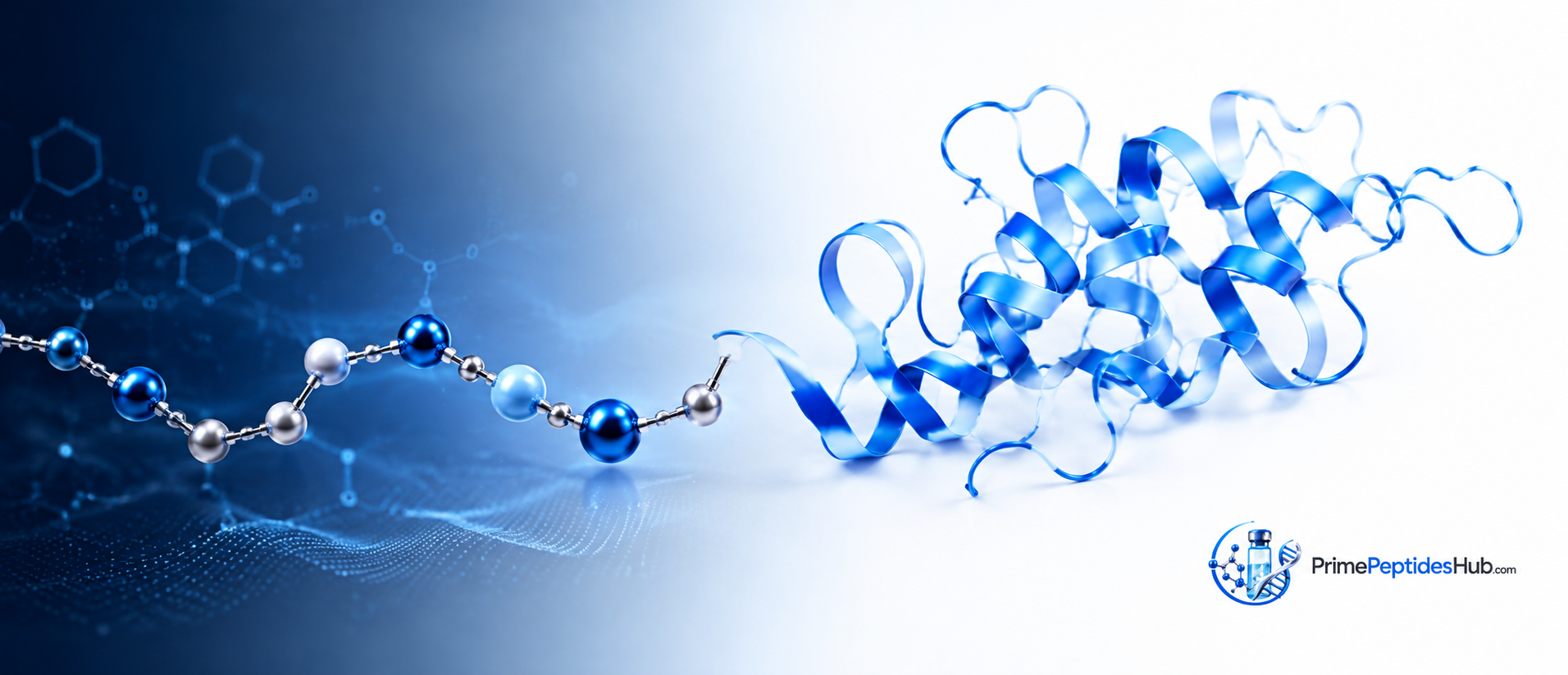
Peptides are often mentioned in laboratory research, biochemical analysis, and product-quality discussions, yet the basic idea is straightforward: a peptide is a chain of amino-acid residues connected in a specific order. That order is called the sequence. Understanding this simple foundation makes it easier to read product information, interpret research documentation, and distinguish a peptide from a larger protein.
What is a peptide?
Amino acids are small molecular building blocks. When amino acids join together, they form a chain. Each amino acid incorporated into that chain is called an amino-acid residue. The covalent connection between neighboring residues is a peptide bond. A molecule containing a relatively short chain of these residues is generally described as a peptide, while longer and more structurally complex chains are commonly described as polypeptides or proteins.
There is no single universal length boundary that separates every peptide from every protein. In practice, the terms reflect chain length, structure, context, and scientific convention. The most important point for a new reader is that both peptides and proteins are built from amino-acid sequences; their length and folding behavior help determine how they are described and studied.
How peptide bonds form
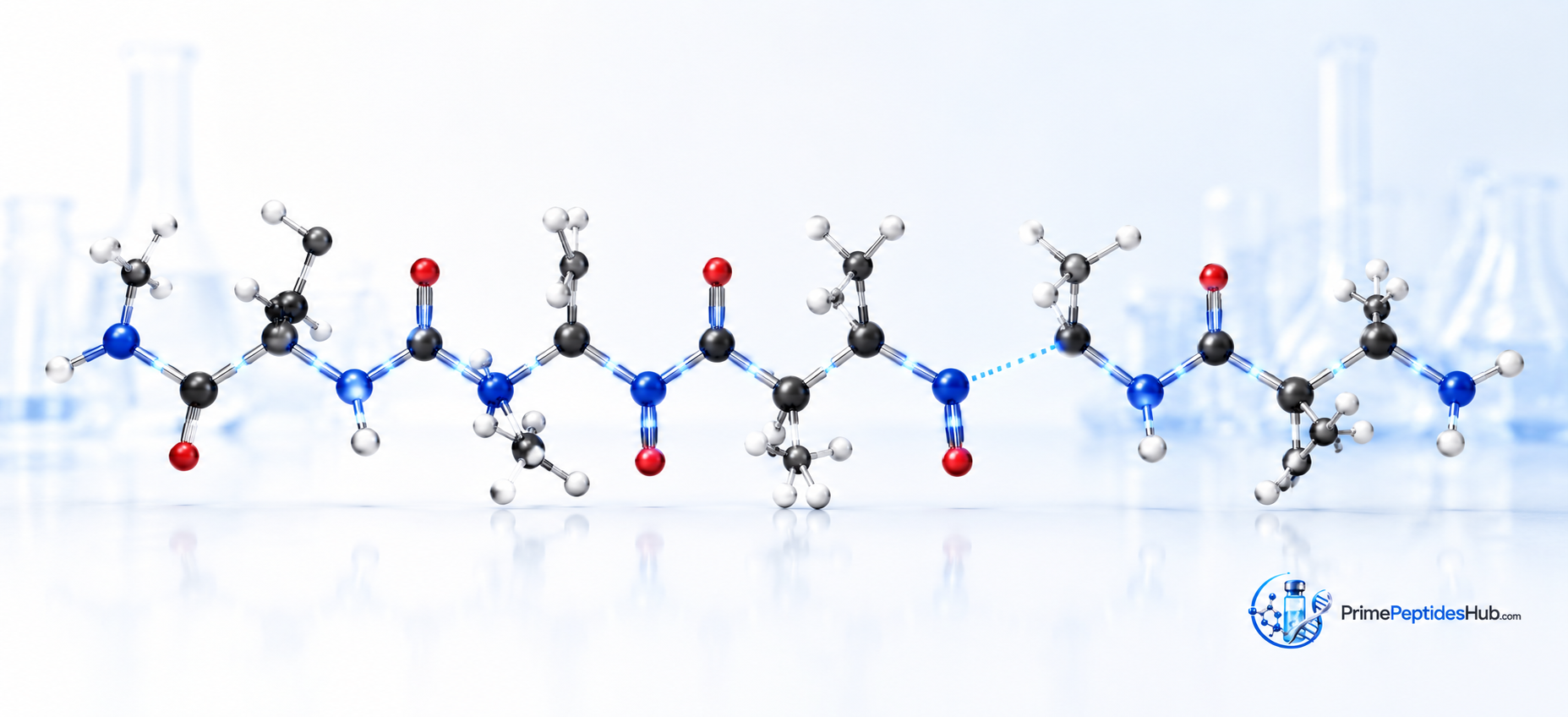
A peptide bond forms when the carboxyl group of one amino acid reacts with the amino group of another. This condensation reaction releases water and creates a stable amide linkage. As additional amino acids are connected, the chain develops two different ends: the amino terminus, or N-terminus, and the carboxyl terminus, or C-terminus. Scientists normally write and read peptide sequences from the N-terminus toward the C-terminus.
Why the peptide sequence matters
A peptide is not defined only by how many amino acids it contains. The identity and order of those amino acids are equally important. Changing even one residue changes the chemical sequence and may alter charge, solubility, stability, folding tendency, or interactions studied in a laboratory model. For this reason, a peptide name, sequence, molecular formula, and expected molecular mass are useful identifiers in technical documentation.
The sequence also gives researchers a reproducible reference. Two samples should not be treated as the same peptide merely because their labels look similar. Strength, formulation, sequence, batch identity, and analytical documentation all contribute to a clear research record.
Peptides and proteins: related, but not identical
Peptides and proteins share the same basic chemistry, but proteins are usually longer and more likely to adopt complex three-dimensional structures. A protein may contain one or more polypeptide chains that fold into an organized shape. Shorter peptides may also adopt local structures, but they are generally discussed as smaller, more focused molecular chains. This distinction is useful when comparing research materials, analytical methods, storage instructions, and documentation requirements.
How research peptides are produced and examined
Peptides occur naturally in biological systems, and they can also be produced for laboratory research. One established production approach is solid-phase peptide synthesis, in which amino acids are added step by step while the growing chain remains attached to a solid support. After synthesis, the material is separated from the support, purified, and examined using appropriate analytical methods.
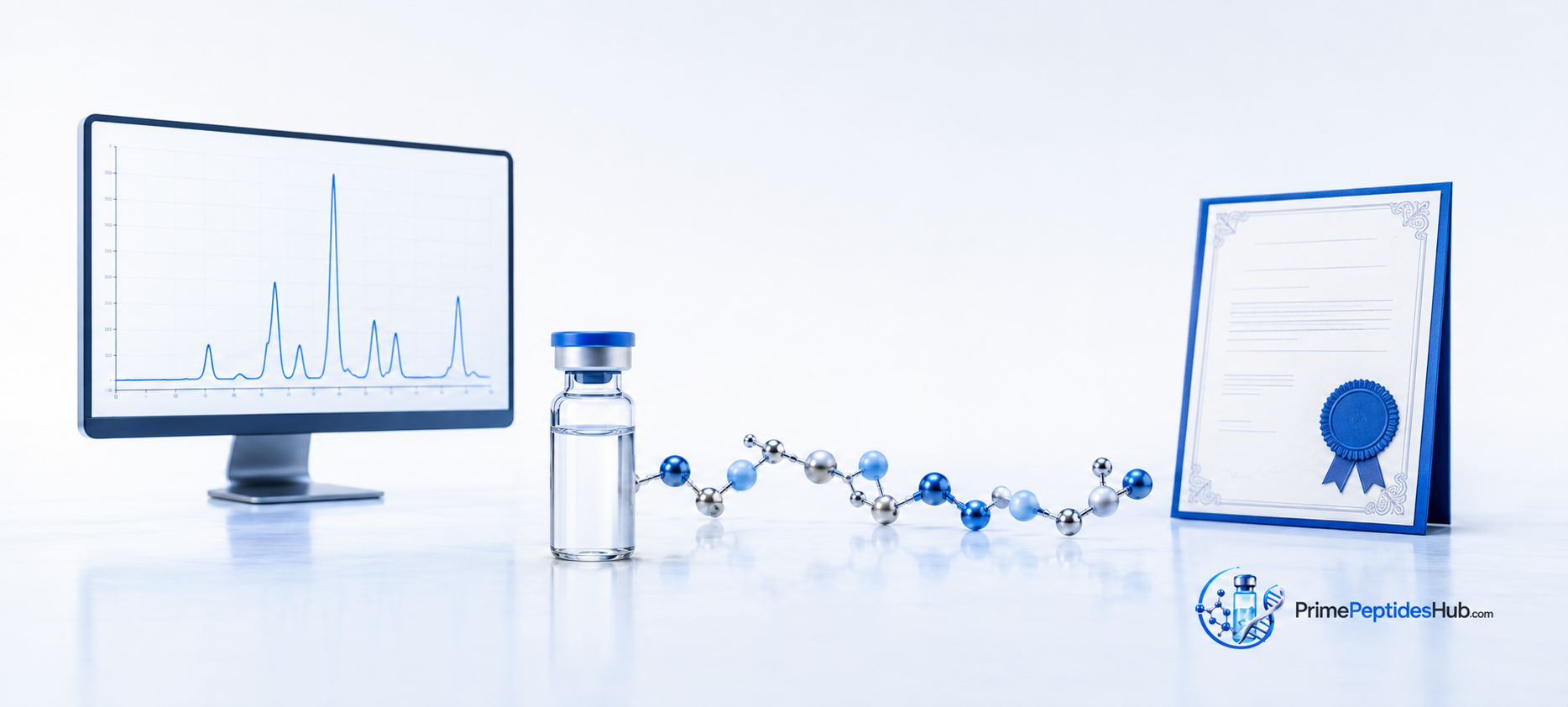
Analytical testing should answer more than one question. Identity testing asks whether the expected molecule is present. Purity testing estimates how much of the analyzed material is represented by the target component under the stated method. Other evaluations may address appearance, water content, residual materials, or additional specifications. A purity percentage by itself is therefore not a complete description of identity, concentration, or suitability for a particular experiment.
Why batch documentation matters
A Certificate of Analysis, commonly called a COA, is a batch-specific summary of reported specifications and test results. A useful COA should connect clearly to the product through a batch or lot identifier and should state relevant methods, results, and dates. Researchers should review whether the document belongs to the exact material they received rather than relying on a generic certificate.
A simple checklist for reviewing a research peptide
• The peptide name and strength are unambiguous.
• The amino-acid sequence or another suitable identity reference is available when relevant.
• The vial or package carries a batch or lot identifier.
• The COA refers to the same batch and states the reported analytical method and result.
• Storage and handling instructions are clearly provided for the unopened and prepared material, where applicable.
• The supplier provides a traceable channel for documentation questions.
How to read a peptide product name
A product name may combine several pieces of information, and each one should be read separately. The peptide name identifies the material; the stated strength describes the labeled amount in the supplied unit; the package description explains how many vials or containers are included; and the batch number links the physical item to its documentation. These fields are not interchangeable. For example, the package quantity does not describe peptide sequence, and a purity result does not replace the labeled strength. Reading each field in its proper role reduces ambiguity and makes comparisons between research materials more reliable.
When two listings appear similar, compare the complete record rather than only the main name. Strength, package configuration, batch, analytical date, and storage instructions may differ even when the peptide name is the same. A careful record should preserve the exact product and batch details used in the laboratory.
Key takeaway
A peptide is a defined chain of amino-acid residues joined by peptide bonds. Its sequence, identity, batch, handling information, and analytical documentation are all part of understanding the material. Learning these fundamentals helps researchers evaluate product information more carefully and maintain clearer laboratory records. Future PrimePeptidesHub learning articles will build on this foundation by examining peptide synthesis, analytical reports, storage principles, and quality terminology in greater detail.