

PUBLISHED: September 5, 2026
READING TIME: 8 minutes
Ipamorelin is a synthetic pentapeptide developed as a growth hormone secretagogue, investigated for stimulating growth-hormone release rather than replacing the hormone. Modified residues were selected during medicinal-chemistry research. Early experiments described a comparatively selective response with less stimulation of certain other pituitary hormones than older secretagogues.
Online discussions expand that description into claims about muscle growth, fat loss, sleep, recovery, anti-aging, or hormone optimization. Those claims exceed the evidence. Published research includes laboratory and animal experiments, human pharmacology studies, and a proof-of-concept trial in postoperative bowel dysfunction. This article explains what studies measured and provides no diagnosis, treatment, dosing, preparation, injection, administration, or personal-use instructions.
What exactly is the ipamorelin peptide?
Ipamorelin is a five-residue peptide commonly described by the sequence Aib-His-D-2-Nal-D-Phe-Lys-NH2. Aib is alpha-aminoisobutyric acid, and D-2-Nal is a nonstandard naphthylalanine residue. The amidated carboxyl terminus and stereochemical configuration are part of the intended identity. These features distinguish ipamorelin from natural ghrelin, from growth-hormone-releasing hormone analogues, and from other growth hormone-releasing peptides such as GHRP-2 and GHRP-6.
A 1998 pharmacology paper introduced ipamorelin as the first selective growth hormone secretagogue. In rat pituitary cells and animal models, it stimulated growth-hormone release through a GHRP-like receptor pathway. The word “selective” described the hormonal profile observed in those controlled models; it did not mean that the molecule had only one biological consequence or that long-term safety was established. Readers new to this field can begin with What Are Peptides? A Simple Introduction.
How does the ghrelin receptor pathway work?
Growth hormone secretagogues signal mainly through the growth hormone secretagogue receptor, GHS-R1a, now widely known as the ghrelin receptor. This receptor is expressed in the pituitary and in other tissues. Its activation can influence intracellular calcium and signaling pathways that promote growth-hormone release. Natural ghrelin also participates in appetite, gastrointestinal motility, energy balance, glucose regulation, and additional physiological processes, showing that the receptor system extends beyond a single hormone measurement.
Growth-hormone release is pulsatile and shaped by hypothalamic GHRH, somatostatin, sleep, nutrition, age, sex, stress, and feedback from GH and IGF-1. A secretagogue response therefore depends on sampling time and experimental context. A brief rise in circulating GH is a pharmacodynamic observation, not direct proof of improved body composition, strength, sleep, tissue repair, longevity, or wellbeing. Those outcomes require their own controlled studies with appropriate comparators and validated endpoints.
What did early selectivity research show?
In early animal experiments, ipamorelin produced strong growth-hormone release while causing less release of adrenocorticotropic hormone and cortisol than some older GHRPs. This profile helped researchers separate growth-hormone secretagogue activity from broader pituitary responses. The comparisons were made under defined laboratory conditions, using particular species, doses, sampling schedules, and reference compounds. Selectivity can change with exposure, assay sensitivity, tissue type, receptor expression, and biological state.
The study did not establish that cortisol, prolactin, glucose, insulin, appetite, or cardiovascular effects are absent in every setting. Separate experimental work in isolated pancreatic tissue reported that ipamorelin could stimulate insulin release through calcium-channel and adrenergic pathways. An isolated-tissue observation cannot predict whole-person metabolic outcomes, but it demonstrates why a narrow marketing description should not substitute for systematic receptor, hormone, and safety profiling.
What has human pharmacology research measured?
A 1999 study used pharmacokinetic and pharmacodynamic modeling to characterize ipamorelin disposition and growth-hormone responses in healthy volunteers across a range of studied exposures. The model linked measured concentrations with the timing and magnitude of GH release. Such work helps researchers estimate onset, clearance, variability, and concentration-response relationships under the conditions tested. It is primarily a tool for understanding drug behavior, not evidence that a desired health outcome occurs.
What did gastrointestinal research find?
Because the ghrelin receptor influences gastrointestinal function, researchers also investigated ipamorelin in models of postoperative ileus, a temporary reduction in bowel motility after surgery. Rodent experiments reported changes in gastric emptying, intestinal transit, food intake, or fecal output under specific surgical models. These animal results supported a clinical hypothesis, but anesthesia, surgery design, species physiology, exposure, and measured endpoints limit translation to human care.
A prospective randomized proof-of-concept study later evaluated ipamorelin after bowel resection. The published conclusion reported no significant difference between ipamorelin and placebo in the primary outcome, although the study described the tested regimen as generally tolerated. This result is important because it shows the difference between biological plausibility and demonstrated clinical effectiveness. A negative or inconclusive clinical endpoint should not be replaced by favorable animal data or general statements about ghrelin biology.
Does the evidence support body-composition or recovery claims?
Robust controlled human trials establishing ipamorelin for muscle gain, fat reduction, injury recovery, sleep improvement, anti-aging, or performance enhancement are lacking. Online claims commonly move through several unsupported steps: ipamorelin can stimulate GH; GH participates in growth and metabolism; therefore ipamorelin must improve a broad outcome. Each step requires direct evidence because hormone changes can have different effects according to baseline status, duration, feedback, tissue exposure, and health context.
Why combinations require separate evidence
Ipamorelin is often discussed together with a GHRH analogue such as CJC-1295. The two classes act through different receptors and may interact at the pituitary. That mechanistic complementarity does not prove that a mixture is effective, predictable, or safe. Evidence for either component alone cannot establish the behavior of a combination, and a study using one formulation, ratio, species, or schedule cannot define another.
Combination experiments require controls for each individual component and the mixture, along with timed hormone measurements, receptor-specific assays, and safety observations. Product identity is also more difficult when two peptides share one preparation because each requires separate confirmation of sequence, content, degradation, and related substances. The research catalog lists materials individually, while research categories provide navigational context rather than evidence of compatibility.
What are the main safety uncertainties?
The FDA lists ipamorelin acetate among bulk substances that may present significant safety risks in certain compounding contexts. The agency cites potential immunogenicity from aggregation or peptide-related impurities, complexity created by unnatural amino acids, serious adverse events in an intravenous gastrointestinal study, and insufficient safety information for other injectable routes. This regulatory statement concerns compounded drug risk; it reinforces the need to distinguish research material from an approved medicine.

Why metabolism and analytical identity matter
Research using high-resolution mass spectrometry found that ipamorelin can be metabolized extensively and that characteristic fragments may appear in urine after the parent compound declines. This illustrates two analytical points: disappearance of the intact peptide does not mean biological or analytical relevance ends immediately, and a detection method must target appropriate parent and metabolite signals. Metabolism may vary with biological system, preparation, exposure, and sampling conditions.
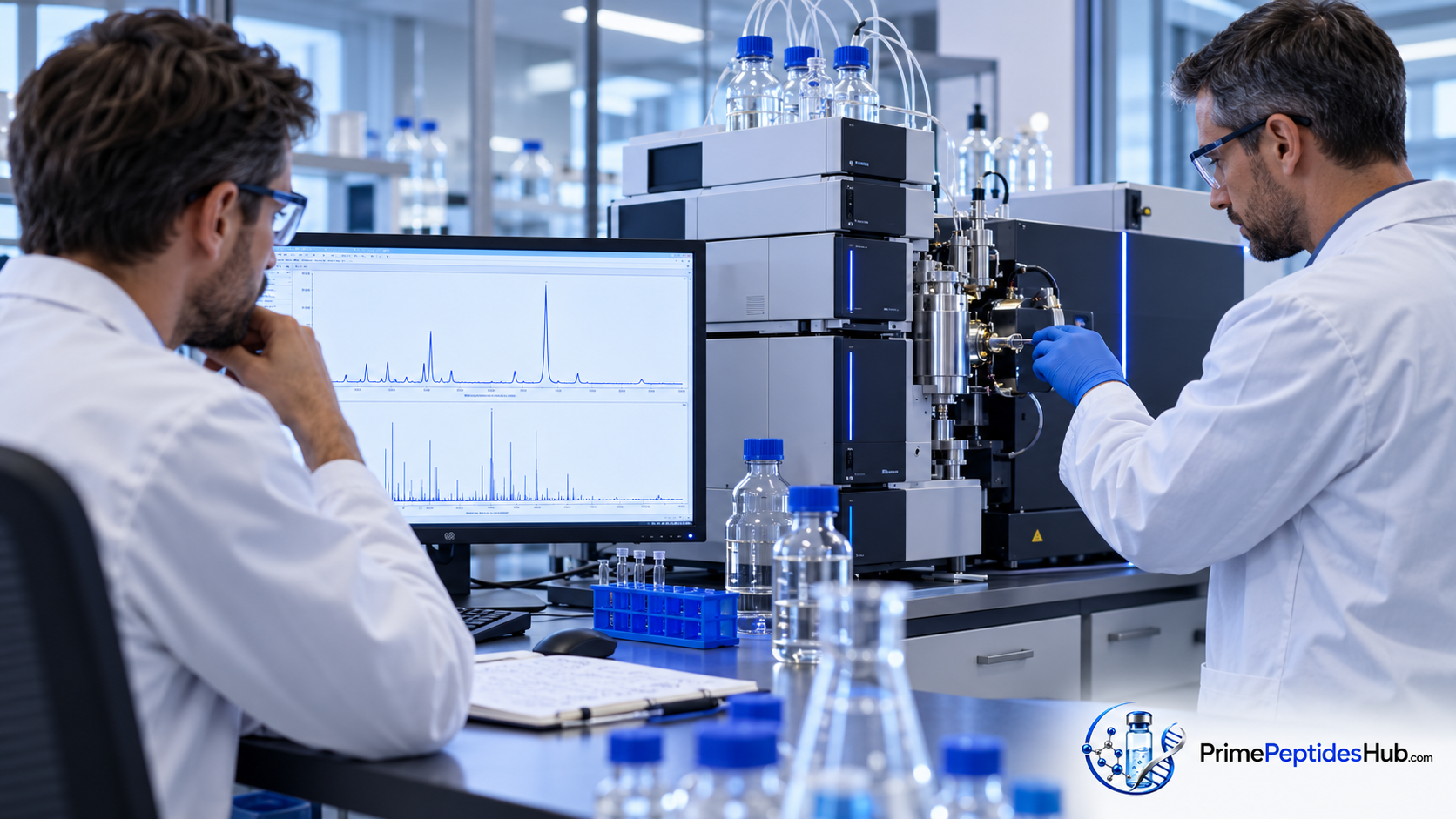
Mass spectrometry can support molecular-mass confirmation, while tandem mass spectrometry provides stronger sequence evidence. Chromatography can estimate purity and related substances, but a high purity percentage does not prove the principal peak is correctly identified. Sequence, stereochemistry, terminal amidation, peptide content, counterion, water, residual solvents, aggregation, oxidation, degradation, microbial quality, endotoxin, and stability are distinct attributes that may require separate validated methods.
Research materials are not finished medicines
A laboratory peptide is not automatically an approved drug, sterile medicine, prescription product, or clinical-trial material. Those categories require defined manufacturing controls, validated release tests, stability programs, sterility assurance where applicable, regulatory oversight, and evidence matched to a specific intended use. A “research use only” label does not demonstrate suitability for injection, hormone management, body-composition change, athletic recovery, sleep improvement, anti-aging, or any personal or veterinary application.
Qualified laboratories should define the precise research question, test material, controls, handling conditions, acceptance criteria, sampling schedule, and analysis plan before work begins. Results should distinguish receptor activation, hormone release, downstream biomarkers, and functional outcomes. Supplier descriptions, mechanistic diagrams, testimonials, and uncontrolled observations cannot replace replicated evidence from a chemically characterized material. The Ipamorelin research listing must be assessed according to its stated specification and batch records.
Why batch documentation matters
A useful Certificate of Analysis identifies the full product name, exact sequence, stereochemical form, terminal modification, salt or counterion, batch or lot, methods, specifications, measured results, laboratory attribution, and report date. Generic certificates, mismatched lot numbers, reused chromatograms, missing raw identifiers, or unexplained methods weaken confidence. The PrimePeptidesHub quality certificates page describes document organization, while the quality commitment explains the site’s approach to traceability and transparency.
Key takeaway
Ipamorelin is a synthetic pentapeptide studied as a comparatively selective growth hormone secretagogue acting through the ghrelin receptor. Early laboratory, animal, and human pharmacology research confirms that it can produce measurable GH responses under controlled conditions. Gastrointestinal research progressed from animal models to a human proof-of-concept trial, but the principal clinical outcome did not show a significant advantage over placebo. Mechanistic activity and clinical effectiveness are not interchangeable.
Evidence remains insufficient for broad claims about muscle, fat loss, sleep, recovery, anti-aging, or performance. Long-term human safety is also not established, and regulatory concerns include immunogenicity, impurities, unnatural amino acids, and limited route-specific information. Responsible evaluation begins with exact chemical identity and batch documentation, then matches every statement to the model, population, comparator, duration, and endpoint actually studied. Scientific uncertainty remains a central conclusion.